Inside the xStocks Wave
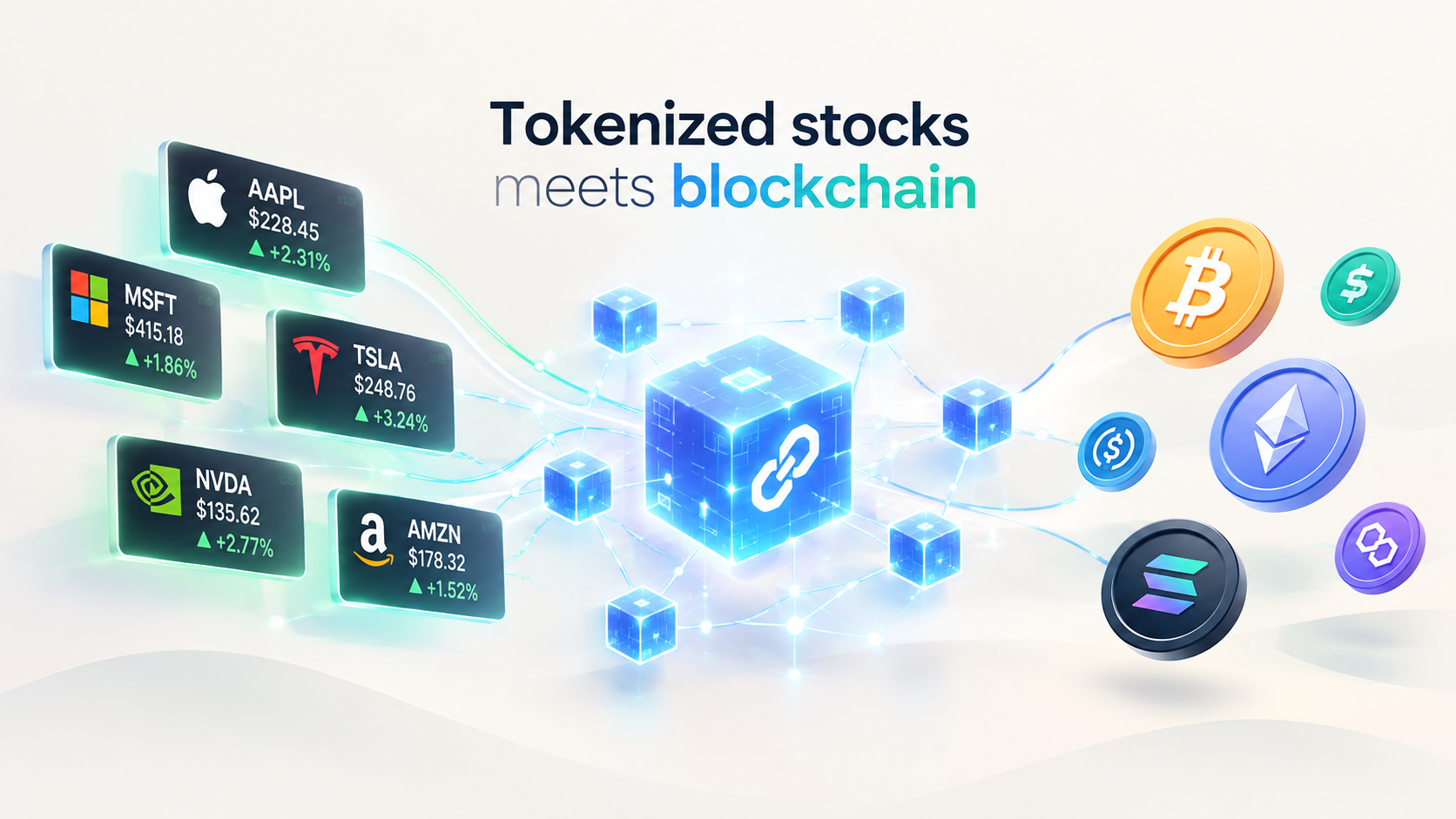
Tokenized equities are booming. Ownership is the fine print.
Crypto & AI MAXI
Something quietly changed on Robinhood Chain in July 2026. A meme coin named CASHCAT — a plain LaunchToken deployed by anyone, with no special permissions — quietly accumulated a $135.6 million market cap and 57,659 holders. In the same window, Robinhood's own official tokenized GameStop and NVIDIA stock tokens together sat at roughly $5.1 million market cap and 51,000 holders [3]. The 24-hour volume gap was even starker: CASHCAT traded $22.5 million in a day, nearly 9x the combined volume of the two flagship "real asset" tokens.
This single data point contains the entire story of tokenized equities in 2026. The plumbing works. The institutional infrastructure is real. Kraken's xStocks network crossed $25 billion in total transaction volume in under eight months, with $3.5B+ onchain volume, 80,000+ unique onchain holders, and nearly $225 million in aggregate AUM [1]. Vlad Tenev, Robinhood's CEO, declared on X in August 2026 that "we are in the early innings of a global tokenization supercycle" — a "freight train that cannot be stopped" [5]. And yet, on the very chain Robinhood built purpose-built for real-world assets, memes drove roughly 51% of spot trading volume in July while RWAs sat at around 5% [3].
So what is retail actually buying? Is it exposure to Apple? Is it a claim on a custodian? Is it a new casino dressed up in equity clothing? The honest answer is that tokenized stocks are all three at once — and understanding which one you are participating in is the difference between using this technology and being used by it.
This post is a technical deep-dive into the tokenized equity stack: how the pairing and custody actually works, why retail adoption is surging on some metrics and flatlining on others, and what the agentic-payments layer (x402, ERC-8004) means for the next phase. All numbers are sourced from live dashboards and official announcements as of October 2026, cited inline with [n] and linked in the References section.
The Plumbing: What "Backed 1:1" Actually Means
[AI-generated image for illustration only.]
The phrase "fully backed 1:1" appears in every tokenized stock marketing page, but the mechanics behind it vary by issuer. For xStocks (Kraken + Backed Finance), each xStock is backed by the underlying stock or ETF held with a licensed custodian in a bankruptcy-remote structure [1]. That means the shares legally sit in a segregated account at a regulated institution, and if the token issuer went under, the shares are not part of the bankruptcy estate — they belong to the holders pro-rata. Kraken acquired Backed Finance AG in December 2025 [8], folding the tokenization infrastructure directly into the exchange.
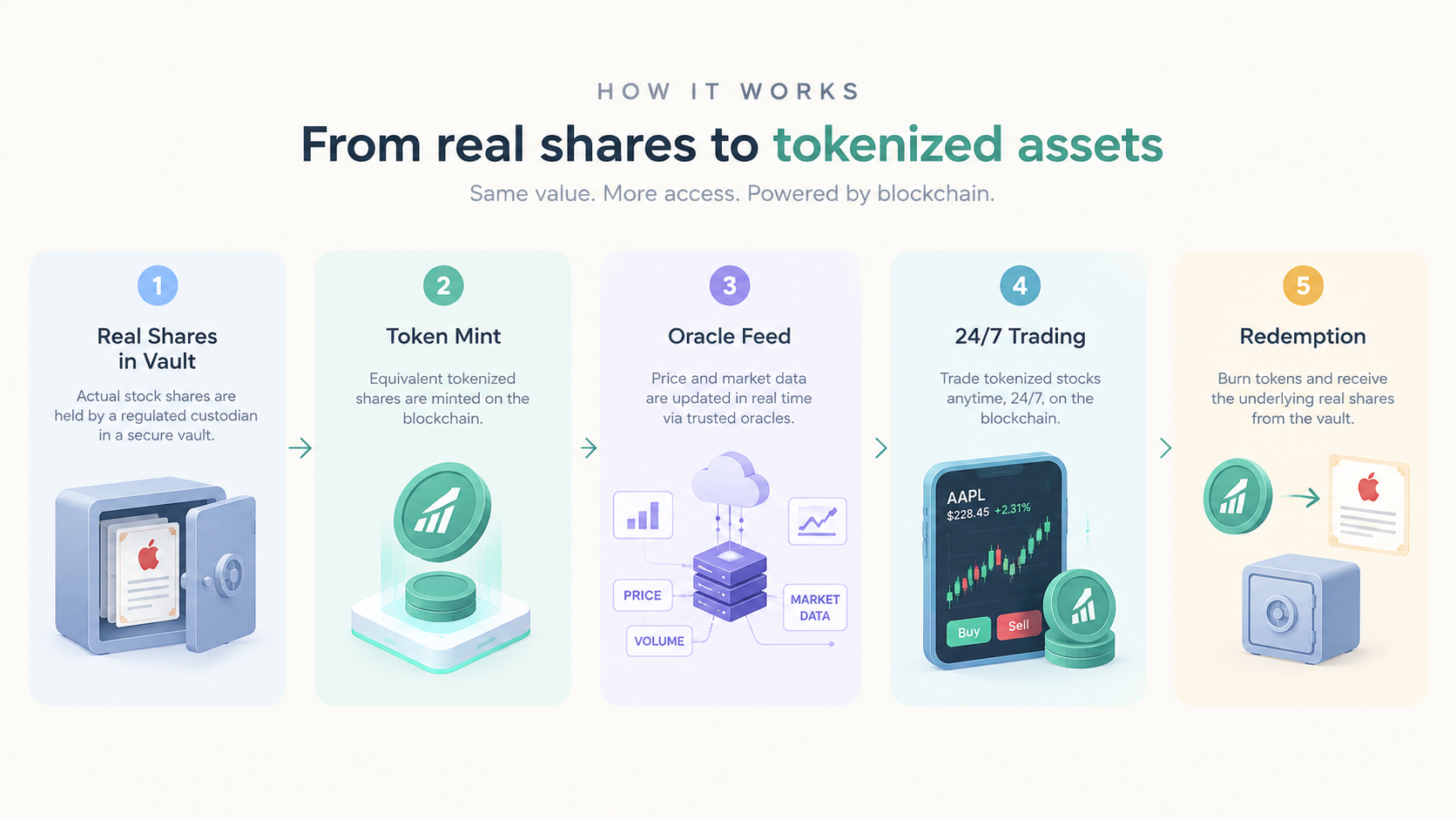
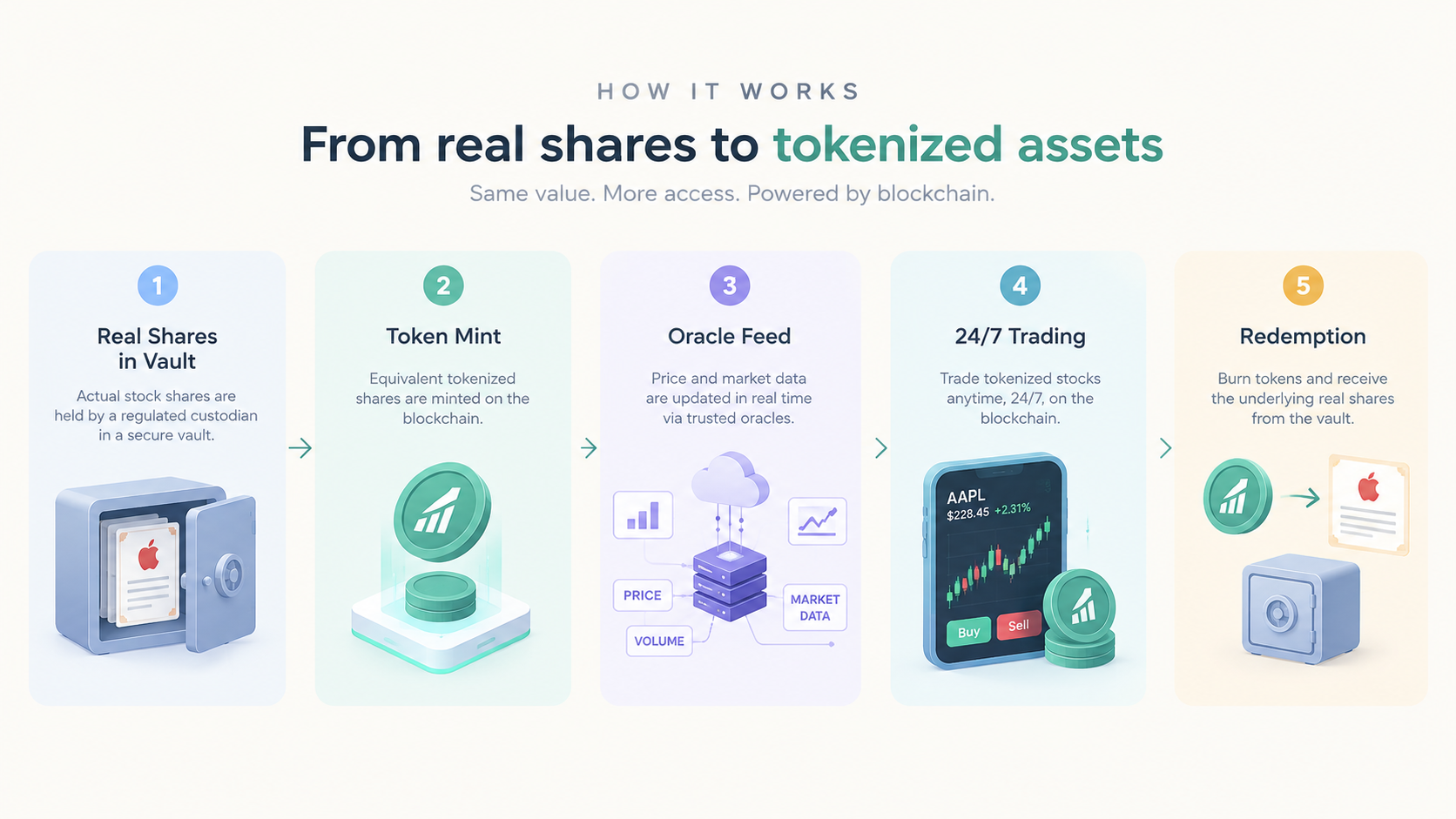
The flow has five moving parts:
Real shares. An issuer like Backed purchases the underlying equity (Apple, Netflix, an ETF basket) through regulated brokers and holds them in custody. These are real securities in a real brokerage account, subject to real corporate actions.
Token mint. Against those held shares, the issuer mints SPL tokens (Solana) or ERC-20s (Ethereum, TON) at a strict 1:1 ratio. Each NFLXx token corresponds to one Netflix share in custody. The mint is permissioned — only the issuer can create new tokens, and only against verified share purchases.
Oracle feed. Onchain applications (AMMs, lending protocols, perp venues) need a live price reference. Chainlink is a named partner in the xStocks alliance [1], and the xStocks team unveiled xBridge with Chainlink to move tokenized stocks between Solana and Ethereum [2]. The oracle price is derived from the underlying market — it is a reference, not the share itself.
Trading. This is where retail lives. xStocks are integrated across exchanges (Kraken, Bybit, OKX, Gate), DeFi protocols, self-custody wallets (Phantom), and consumer apps — live on Solana, Ethereum, and TON [1]. The trading is 24/7, fractional, and permissionless in the sense that anyone with a wallet can hold or transfer. Robinhood Stock Tokens offer 24/7 trading on Robinhood Chain, deployable into lending pools and usable as collateral across DeFi [4].
Redemption. Burn the token, and the issuer releases the underlying share (or its cash equivalent) from custody. This is the peg mechanism — if the token trades at a sustained premium or discount to the real share, arbitrageurs mint or redeem to close the gap.
The critical detail that marketing pages under-emphasize: you are not holding a share certificate. You are holding a tokenized claim on a custodian, denominated in share units, priced by an oracle, and tradable on any venue that lists it. That claim is only as good as the custodian's segregation, the issuer's mint discipline, and the oracle's uptime.
Why Retail Suddenly Cares: Access, Not Yield
[AI-generated image for illustration only.]
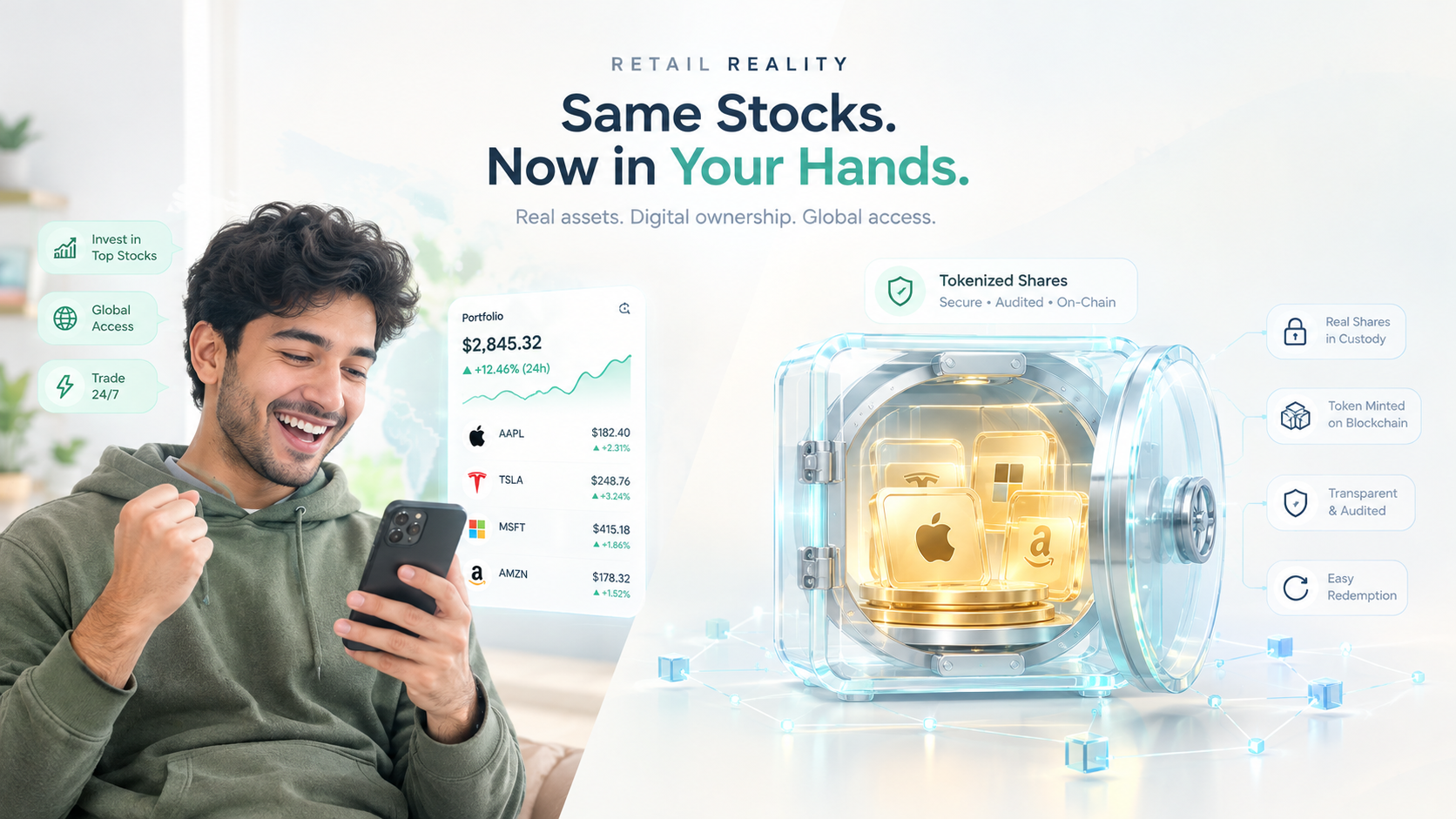
The retail adoption story is not about yield farming or DeFi alchemy. It is about access — specifically, geographic access to high-quality US equities that traditional brokers make hard or expensive to get. Vlad Tenev's August 2026 X post frames it precisely: Stock Tokens give "people in over 120 countries economic exposure to 190+ US stocks, backed 1:1 by underlying shares" [5]. Robinhood Chain became the fastest EVM chain to reach 100 million transactions, driven partly by weekend stock-token trading in jurisdictions where Monday-to-Friday brokers are the only option.
The retail pitch has four legs, and each one solves a real friction point:
24/7 access. The internet doesn't sleep, and neither do crypto markets. A trader in Jakarta or Lagos can buy tokenized NVDA exposure at 3 AM local time, when the Nasdaq is dark. Robinhood noted that "the internet doesn't sleep, and markets shouldn't either" [5], and the data backs it — Robinhood Chain was built on the Arbitrum platform and hit 100M transactions fast, partly on weekend volume [4].
Fractional from any size. A $500 Apple share splits into 500 tradable units of $1. No minimum lot sizes, no odd-lot penalties, no broker account tiers. Retail can size a position to their actual conviction instead of the share price.
Programmability. This is the genuinely new part. A tokenized stock can be collateral in a lending pool, half of a liquidity pair, an input to an automated strategy, or an asset an AI agent can trade. Robinhood explicitly pitches "asset productivity" — deploying tokens into lending pools and using them as trading collateral across DeFi [4]. A traditional brokerage share cannot do any of this.
Distribution through crypto rails. xStocks ships through Kraken, Bybit, OKX, Gate, Phantom, Jupiter, and Telegram Wallet [1][2]. This reaches demographics that a US brokerage account never touches — users who already hold stablecoins and want equity exposure without a new KYC process at a traditional broker.
Crypto.com's research team summarized the structural shift in July 2026: tokenized stocks bring "24/7 global market access, T+0 atomic settlement, and lower barriers to entry" [7]. The tokenized stock market surged 149% year-to-date to ~$1.7B by June 2026, with monthly trading volumes exceeding $6.7B [7]. FalconX put the total tokenized stock market cap at nearly $1.5B as of June 9, 2026 — a nearly 5x growth since 2025.
But here is the tension the retail pitch rarely addresses. Robinhood's own CEO admitted the "glaring gap": Stock Tokens are not yet available in the US [5]. The jurisdictions where they are available are precisely the ones where retail equity access was already the weakest. So the adoption curve is not "everyone loves tokenized stocks" — it is "people who were locked out of US equities now have an on-ramp." That is a genuine unlock, but it is a narrower story than the "tokenization supercycle" framing suggests.
The Paired-Coin Problem: Memes Out-Trading RWAs
[AI-generated image for illustration only.]
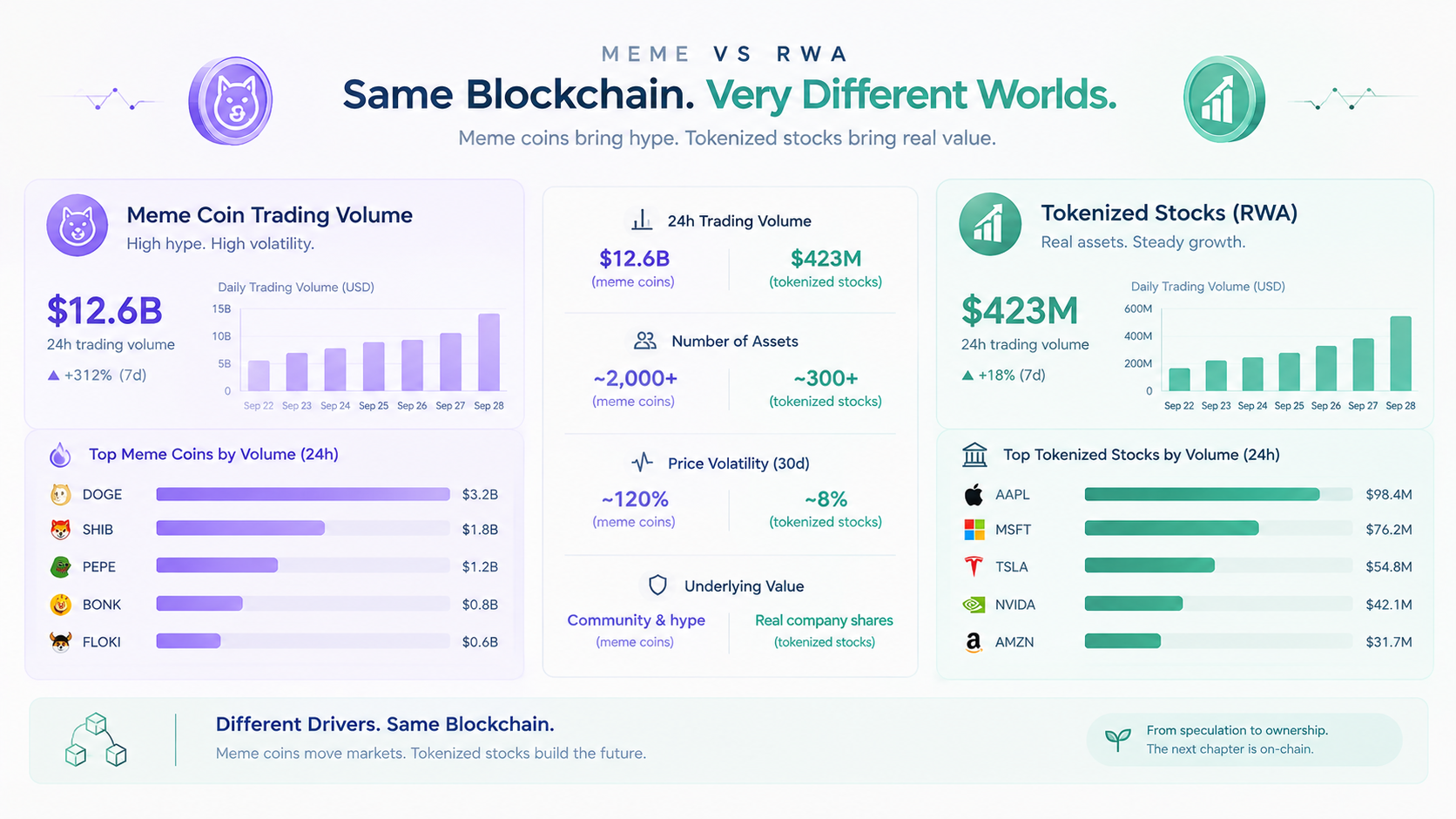
Here is where the technical reality gets uncomfortable. Robinhood Chain launched its mainnet on July 1, 2026, built "using the Arbitrum Platform to institutional standards" with day-one DeFi partners including Uniswap and Pleiades deploying dedicated AMMs [4]. The positioning was unambiguous: this is the RWA chain. And within a month, the data showed memes dominating the very volume the RWAs were supposed to anchor.
The Blockscout analysis pulled live explorer data on August 11, 2026 and found: meme coins made up roughly 51% of Robinhood Chain's spot trading volume in July, RWAs about 5% [3]. A separate CoinGecko analysis of DEX volume as of July 27 put memecoins at 79.2% of DEX volume, RWAs at 9.69%, and other pairs (WETH, ETH, stablecoins) at 11.1% [3]. CASHCAT alone logged $824.89 million in lifetime volume across 1.37 million trades by late July [3].
Meanwhile, RWA value was growing fast in absolute terms: roughly $12.8M shortly after launch, to $25.4M by July 24, to around $70M by late July — a roughly fivefold increase across the month [3]. So the pie was growing, but the meme slice was growing faster, and the absolute RWA number was still tiny compared to the total tokenized stock market ($1.5-1.7B across all chains).
Three technical observations matter here.
The verification trap. On Robinhood Chain, official Robinhood stock tokens are BeaconProxy contracts pointing at a shared "Stock" implementation, flagged is_verified_via_admin_panel: true on Blockscout. Searching "GME" turns up seven results — only one carries that flag. The other six are unverified or independently deployed contracts using the same name and ticker [3]. A retail user who does not know to check the admin-panel flag can easily buy a fake "GameStop token." This is a real and current risk on permissionless RWA chains.
The gas subsidy experiment. Robinhood covered transaction fees for eligible users through roughly late September 2026 [3]. Once users pay their own gas, that is the first honest test of whether meme trading volume holds on its own economics. As of this writing (mid-October), the subsidy has ended and the post-subsidy volume data is the next thing to watch.
The monetization irony. Regardless of volume composition, Robinhood Chain generated $3.6 million in Real Economic Value in July 2026 — 38% of all L2 revenue tracked by growthepie, more than Polygon or Base [3]. Robinhood monetizes the chain either way. The memes are not a failure of the RWA thesis; they are a revenue stream that subsidizes the RWA infrastructure buildout.
The paired-coin phenomenon — someone launching a memecoin named after or paired to a tokenized stock — is the retail froth riding the tokenization narrative. It is worth watching not because it is legitimate, but because it is where the retail money actually went first. The honest read: retail traders on new permissionless chains behave like retail traders everywhere. They reach for the casino first and the index fund later, if at all.
The Agentic Layer: When Your Portfolio Manager Is Software
[AI-generated image for illustration only.]
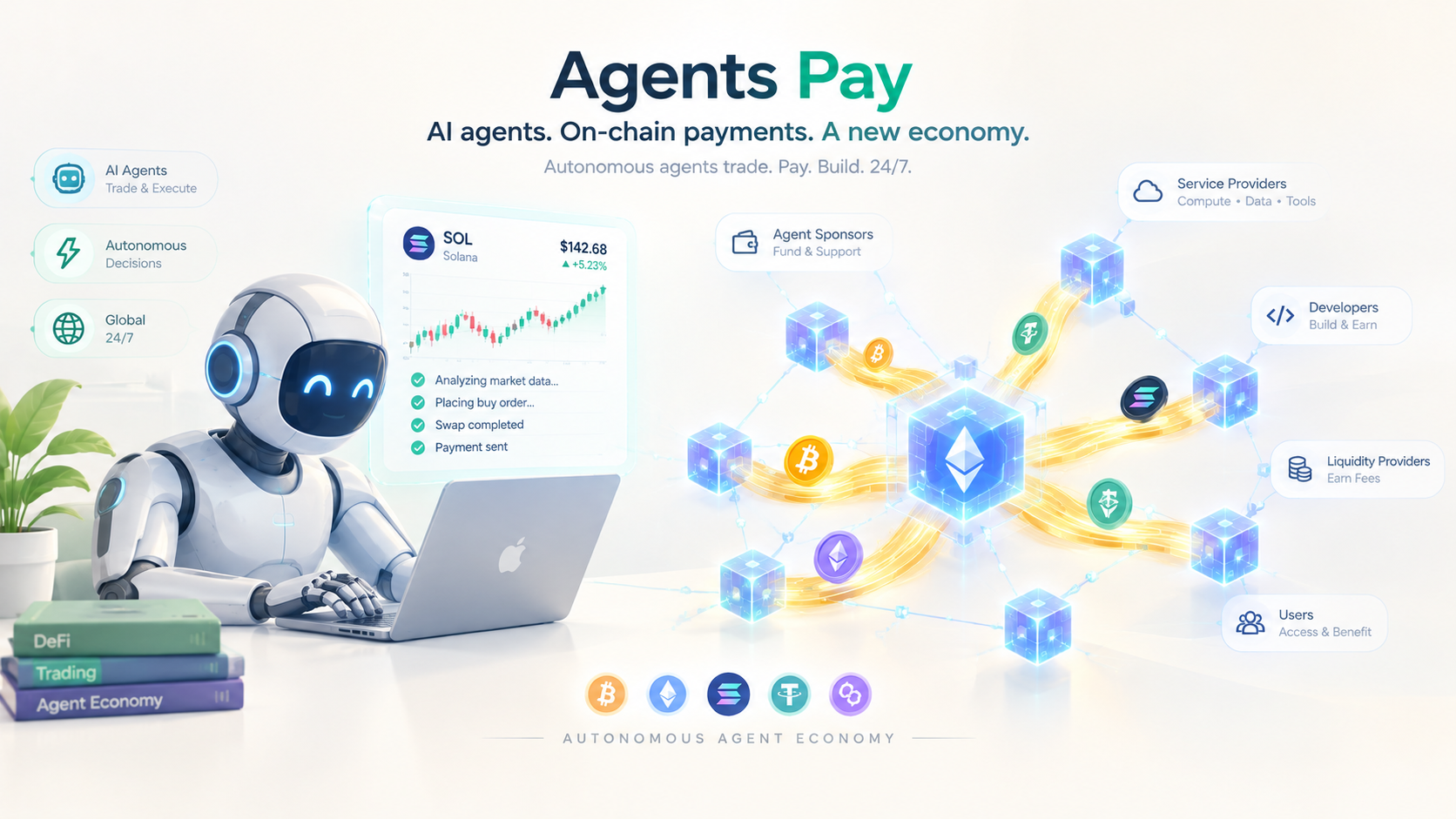
The most under-discussed development in tokenized equities is not the tokens themselves — it is who will be trading them. Robinhood launched Agentic Trading for equities and options in the US in mid-2026, then announced Agentic Accounts for crypto using its Trading MCP: "eligible US traders can connect their AI model of choice to Robinhood data sources and tools. Your agent can continuously scan millions of data points and execute strategies the moment the market turns" [4]. Humans remain in control of capital allocation and safety guardrails. Robinhood even set a Guinness World Record for "the most items purchased by an AI agent in three minutes using a single credit card" [4].
This connects directly to the x402 protocol — the HTTP-native payment rail named after status code 402 ("Payment Required") that lets machines pay for resources inside web requests. Chainalysis reported in June 2026 that x402 agentic transactions on Base went from near-zero in mid-2025 to well over 100 million cumulative transactions through Q1 2026 [6]. Transactions of $1+ now represent 95% of total volume transferred, up from 49% in early 2025 [6]. The agents using these rails are younger wallets, hold 550% more asset types, and carry smaller balances than typical Base users [6].
Now merge the two rails in your head: an AI agent holding a self-custodial wallet, discovering a paid price-data endpoint, paying per call via x402 stablecoin micropayments, reading the NVDAx price feed, and executing a tokenized-stock swap at 3 AM Sunday on a Robinhood Chain AMM — all without a human in the loop for any single trade. The x402 whitepaper explicitly frames the goal as removing "the friction of traditional payment rails, enabling real-time, pay-per-use" machine transactions [9]. ERC-8004, the onchain agent identity standard, adds the missing piece: a verifiable identity for the agent itself, so counterparties and protocols can check who they are dealing with before they execute.
This is not speculative fiction. The components are live: x402 on Base (100M+ txns), Robinhood's Trading MCP for agentic accounts, tokenized stocks trading 24/7 on permissionless DEXes, and agent identity standards shipping. The convergence point — an autonomous agent trading tokenized equities, paying for its own data, on a 24/7 chain — is where this stack goes next. And the honest caveat from Chainalysis: much of the early x402 growth "was driven by meme coin farming activity" [6], the same froth pattern as Robinhood Chain's volume composition. The rails are real; the use cases are still finding their footing.
What Retail Should Actually Check
[AI-generated image for illustration only.]
If you take one technical lesson from this post, make it this checklist — drawn from the failure modes visible in the live data above.
Verify the token, not the ticker. On Robinhood Chain, search "GME" and get seven results. Only one is the real token, identified by the is_verified_via_admin_panel flag and the shared "Stock" implementation contract [3]. On xStocks, check that the issuer is Kraken/Backed and the token appears on xstocks.fi with a matching product page [1]. A ticker match is not verification.
Know who the custodian is. "Backed 1:1" is only meaningful if the custodian is named, licensed, and the structure is bankruptcy-remote [1]. Read the Base Prospectus and Final Terms — xStocks publishes them at assets.backed.fi/legal-documentation [1]. If the issuer does not name the custodian, you are holding an IOU with extra steps.
Understand the oracle dependency. Your token's onchain price is set by an oracle feed (Chainlink for xStocks [2]), not by the underlying share directly. During volatile opens or thin off-hours, the oracle price can diverge from the real market. If you are using the token as collateral or in a perp, the liquidation engine reads the oracle, not Nasdaq.
Check geo eligibility. xStocks are "not available in the U.S. or to U.S. persons" [1]. Robinhood Stock Tokens are available in "more than 120 countries" but "availability varies by jurisdiction" [4]. The token existing onchain does not mean your wallet is eligible to mint, redeem, or in some cases even hold it.
Watch the redemption mechanics. If the token trades at a sustained premium to the underlying, arbitrageurs mint more (buy shares, mint tokens, sell tokens). If at a discount, they redeem (buy tokens, burn, sell shares). If redemption is slow, permissioned, or gated, the peg is weaker than the marketing suggests. Check how long redemption actually takes before you size a position that depends on it.
Treat the memes as memes. A paired coin riding a tokenized-stock narrative is not equity exposure. It is a speculative token with a stock-themed name, on a chain where memes already out-trade the actual RWAs [3]. The fact that CASHCAT out-volume official stock tokens 9:1 is not a bullish signal for tokenized equities — it is a signal that retail speculation found a new playground.
Where This Goes: Three Realistic Scenarios
Scenario 1: The access thesis wins (most likely near-term). Tokenized stocks keep growing in the jurisdictions where traditional equity access is weakest. The $1.5-1.7B market cap [7] grows to the tens of billions as more issuers (Backed, Robinhood, and the "8 of the top 11 tokenized equities by unique holders are xStocks" [1] cohort) expand distribution. The 24/7 and fractional properties become table stakes, and the composability (collateral, lending) becomes the differentiator. This is the Vlad Tenev "freight train" scenario, and it does not require US regulatory clarity to keep rolling — it just requires continued expansion in non-US markets.
Scenario 2: The memes subsume the RWAs (the Robinhood Chain risk). If meme volume stays at 51-79% of chain activity [3] while RWA share stagnates, the "RWA chain" becomes a casino with an equity annex. The gas subsidy ending in late September 2026 [3] is the first real test. If post-subsidy volume collapses or shifts further toward memes, the thesis that permissionless chains can host serious equity infrastructure takes a serious hit. The counter-argument: Robinhood monetizes either way ($3.6M July REV, 38% of L2s [3]), so even the "failure" case funds the buildout.
Scenario 3: Agents become the primary traders (the 2027+ wildcard). x402 crosses from meme-coin farming (the current driver [6]) into real agentic commerce — data APIs, compute, and yes, tokenized equities — as ERC-8004 identity standards mature. Robinhood's Agentic Accounts [4] move from US rollout to global, and the "retail investor" on these chains is increasingly an agent with a wallet, a budget, and a strategy. In this world, the tokenized equity market is not retail-sized at all — it is machine-sized, and the 24/7 property stops being a retail convenience and becomes a structural requirement.
None of these scenarios require the technology to fail. They differ on who uses it and what for — and that is the question the live volume data will answer over the next two quarters.
Disclaimer
This blog is AI-written, including the images, which are AI-generated for illustration only. Nothing in this post should be read as an endorsement of any project, token, or protocol.
This blog post is for educational and informational purposes only. Nothing here is financial advice, and no project, token, chain, or protocol mentioned in this post is being shilled, endorsed, or recommended for investment. The author has no financial relationship with any project discussed (Kraken, Backed Finance, Robinhood, Chainlink, Blockscout, Chainalysis, Crypto.com, or FalconX) and receives no compensation from any of them.
Tokenized securities involve substantial risk, including but not limited to: custodian insolvency or segregation failure, oracle price divergence, regulatory prohibition in your jurisdiction, smart contract exploits, liquidity evaporation, and the complete loss of capital. Past performance and cited volume figures are not indicative of future results. Numbers referenced (market caps, volumes, holder counts) are point-in-time snapshots pulled from public sources on the dates cited and may have changed materially since publication.
Always conduct your own research, verify token contracts independently before interacting with them, check your local regulations regarding tokenized securities, and never invest more than you can afford to lose entirely. The author takes no responsibility for any funds lost, gains missed, or decisions made based on this content.
About the Author
MD Ayaan Siddiqui is a Full Stack Blockchain Developer with over 2 years of experience, working across DeFi, stablecoin and smart contract systems, and an independent researcher focused on agentic infrastructure on blockchain: the x402 payment protocol for autonomous AI agents, ERC-8004 decentralized identity, and the onchain mechanics of tokenized real-world assets. He holds a B.Tech in Computer Science and an Online MBA in Blockchain Management from Italy.
His published research includes:
Agentic Infrastructure on Blockchain: A Cross-Chain Architecture for x402 and ERC-8004 - https://zenodo.org/records/21394562
Autonomous Agent Economies on Blockchain: Business Models and Value Creation via the x402 Protocol in Web3 - https://zenodo.org/records/21730620
Solidity Smart Contracts: From Zero to Production (technical ebook) - https://leanpub.com/solidity-ebook
He writes about the intersection of crypto plumbing and retail adoption. You can find his work and portfolio at moayaan.com.
References
[1]: Kraken xStocks — "$25 Billion in Total Transaction Volume" milestone announcement (Feb 2026) and xstocks.fi product page: https://blog.kraken.com/product/xstocks/25-billion-in-total-transaction-volume and https://xstocks.fi/
[2]: Backed Finance and Chainlink xBridge announcement — moving tokenized stocks between Solana and Ethereum: https://xstocks.fi/us/news (xStocks newsroom, "Backed, Chainlink Unveil xBridge to Move Tokenized Stocks Between Solana and Ethereum")
[3]: Blockscout — "Robinhood Chain: Memes, RWAs, and the Live Numbers Behind the Headlines" (Aug 11, 2026 data pull): https://www.blog.blockscout.com/robinhood-chain-memes-vs-rwas-live/
[4]: Robinhood Newsroom — "Robinhood Accelerates Global Expansion with Robinhood Chain Mainnet, Stock Tokens, Agentic Trading and New Suite of DeFi Products" (Jul 1, 2026, updated Jul 30, 2026): https://www.robinhood.com/us/en/newsroom/robinhood-accelerates-global-expansion-robinhood-chain-mainnet-stock-tokens-agentic-trading/
[5]: Vlad Tenev (@vladtenev) on X — "Tokenized Stocks in America" (Aug 18, 2026): https://x.com/vladtenev/status/2089813816611922368
[6]: Chainalysis — "Agentic Payments Cross the Threshold: Inside x402's Path to Meaningful Adoption" (Jun 3, 2026): https://www.chainalysis.com/blog/x402-agentic-payments-adoption/
[7]: Crypto.com Research & Insights (@cryptocom_rni) on X — tokenized stock market update (Jul 15, 2026): https://x.com/cryptocom\_rni/status/2077339915470201082
[8]: Kraken Newsroom — "Kraken to acquire Backed, accelerating xStocks expansion" (Dec 2, 2025): https://blog.kraken.com/news/backed-acquisition
[9]: x402 Whitepaper (Jun 2026): https://x402.org/wp-content/uploads/sites/10/2026/06/x402-whitepaper.pdf


